Showing posts with label Michael Jackson's Glove. Show all posts

Saturday, March 12, 2011

New Michael Jackson video premieres


A new Michael Jackson music video has premiered online.

The clip is for Jackson's second posthumous single 'Hollywood Tonight', which is taken from his album Michael.

Led by Sofia Boutella, the French dancer leads the promo with dance routines that are heavily inspired by Jackson's own iconic movements.

Its main focus is the struggle of a dancer moving to Los Angeles to pursue her dream of success.

The video was aptly shot in Hollywood by director Wayne Isham, who also worked with Jackson on his 1995 hit 'You Are Not Alone'.

Jackson's children recently revealed that they want to follow the career of their father.

Thursday, January 13, 2011

Jackson doctor to stand trial for manslaughter

A judge on Tuesday ordered Michael Jackson's personal doctor to stand trial on involuntary manslaughter charges for allegedly killing the singer with an overdose of powerful sedatives.

Conrad Murray, who claims he was just treating the pop icon for insomnia when he died in June 2009, also had his license to practice medicine in California suspended.

The doctor will be arraigned on January 25, the Los Angeles Superior Court judge ruled after six days of hearings which heard evidence that Murray tried to cover having given Jackson an overdose of the drug propofol.

Jackson's death shocked the entertainment world and triggered intense debate over the performer's health in the run-up to the London concerts, known as the "This is It" tour.

Murray, who was born in Grenada and raised in Trinidad before he moved to the United States, could face up to four years in jail and lose his doctor's license if the case goes to full trial and he is convicted.

Prosecutors claim his defense team will argue that Jackson effectively killed himself by administering an extra dose of propofol while Murray was out of the room, although the defence have not commented on this.

Specifically they allege that Murray, 57, "abandoned his patient" after administering the propofol some time between 10:40 am and 11:00 am to help Jackson sleep, and then tried to cover it up after the singer's death.

Tuesday's widely-expected ruling came shortly after a forensic expert testified Tuesday that Jackson's death was homicide, saying the singer was in generally good health when he died on June 25, 2009 at his LA mansion.

Christopher Rogers, head of forensic medicine for the Los Angeles County coroner's office, said the star died of acute intoxication with propofol, which is usually used as an anaesthetic in hospital settings.

He said he would describe Jackson's death as homicide even if, as claimed by Murray, the singer had himself administered an extra dose of propofol while the doctor was out of the room.

"Based on the quality of the medical care, I would still call this a homicide, even if the doctor did not provide the propofol to Mr Jackson," he said, on the second week of the pre-trial hearings.

Last week the pre-trial hearings heard from a series of witnesses who testified that Murray delayed calling 911, tried to conceal what drugs he had administered, and did not know how to carry out emergency resuscitation.

Paramedic Martin Blount said that when he arrived Jackson seemed to have been dead for at least 20 minutes, despite Murray's claim that he had stopped breathing a minute before they were called.

He added that Murray initially denied having given Jackson any medications, but said he saw the doctor holding a needle and spotted three bottles of the anesthetic Lidocaine on the floor.

On Friday investigator Elissa Fleak said she found 12 vials of propofol in Jackson's house after he died, while a pharmacist testified Monday that he supplied 255 vials of the drug to Murray in the two months before his death.

On Tuesday forensic expert Rogers said propofol should not be used to treat insomnia, adding that he was told "that the doctor left Mr Jackson while he was anesthetized, and this is something you would not do."

"Bad things can happen very quickly" when a patient is anaesthetized, he added.

Various members of Jackson's family have been attending the LA pre-trial hearings. On Tuesday they included sisters Janet and LaToya and his brother Randy.

Sunday, January 9, 2011

Waitress was on phone to doctor of dying Jackson

A cocktail waitress recounted how she was called by Michael Jackson's personal doctor the day the pop icon died and heard a "commotion," apparently as the medic struggled with the crisis.

Sade Anding, of Houston, Texas, was one of 11 people with whom the physician, Conrad Murray, spoke by telephone in the hours leading up to Jackson's shock death on June 25, 2009.

In other testimony at hearings into whether Murray should stand trial for involuntary manslaughter, the court heard that 12 vials of the powerful sedative propofol which killed Jackson were found in a closet at his home.

The waitress said she had met Murray in a Texas steakhouse in February 2009. The pair had exchanged phone numbers, and she received a call from the doctor on the morning of the fateful day.

"He told me that he was doing well," she said, adding she had cut him off and started talking, but realized five or 10 minutes later that Murray was no longer on the phone.

"I heard a commotion... coughing, mumbling of voices," she said, adding that she was unsure if the mumbling was coming from Murray.

Anding said she stayed on the phone for about five minutes, saying it was unusual for Murray to stop responding. "I just remember saying, 'Hello? Hello? Hello? Are you there?' Are you there? Are you there?'" she said.

The waitress eventually hung up and tried to call Murray back and send him text messages, but got no reply.

Prosecutors allege that Murray, 57, negligently administered an overdose of the powerful sedative propofol to help Jackson sleep and then tried to cover it up. The doctor denies the charge of involuntary manslaughter.

Paramedics and emergency room doctors this week have said Murray initially failed to mention having administered propofol, and that Jackson appeared to have died at least 20 minutes before they arrived at his mansion.

On Thursday paramedic Martin Blount said that when he arrived Jackson seemed to have been dead for at least 20 minutes, despite Murray's claim that he had stopped breathing a minute before they were called.

Blount added that Murray initially denied having given Jackson any medications, but said he saw the doctor holding a needle and spotted three bottles of the anesthetic Lidocaine on the floor.

In new evidence Friday coroner's investigator Elissa Fleak said she found 12 vials of propofol in the wake of Jackson's death.

One was found empty on the floor near the singer's bed shortly after his death, while the other 11 were discovered four days later in a closet at his rented home.

Two had been opened and were found inside a dark-blue Costco bag, while the other nine, some of them open, were found in another bag, Fleak said.

Anding meanwhile said she heard nothing more until police contacted her. She called Murray, who apologized for involving her, and urged her to call his lawyer to be present if she met with detectives.

Los Angeles detective Dan Myers told the hearing that Murray had made or received 11 cellphone calls, totaling some 90 minutes of conversations, in the roughly five hours leading up to midday on the fateful day.

These included a 32-minute call to his medical practice in Las Vegas and an 11-minute call shortly before Murray called Jackson's personal assistant at 12:12 pm to say the singer had had a "bad reaction."

Prosecutors allege that Murray "abandoned his patient" after administering the propofol some time between 10:40 am and 11:00 am.

Murray could face up to four years in jail and lose his doctor's license if the case goes to full trial and he is convicted.

Jackson's death shocked the entertainment world and triggered intense debate over the performer's health in the run-up to the London concerts, known as the "This is It" tour.

Monday, January 3, 2011

Discovery cancels Michael Jackson autopsy TV show

The Discovery television network on Friday said it canceled plans to air a reenactment of the autopsy on Michael Jackson's body, citing an upcoming court hearing and concern by the late pop star's estate.

The show, "Michael Jackson's Autopsy: What Really Killed Michael Jackson," had been set to air in several countries of western Europe and in the United Kingdom on Jan. 13.

"Given the commencement of legal proceedings beginning next week, and at the request of Michael Jackson's estate, the scheduled broadcast of the medical documentary related to Michael Jackson's official autopsy has been postponed indefinitely," Discovery Networks International said in a statement.

A Discovery (DISCA.O) spokesman declined comment beyond the statement. Co-executors of the estate responded in their own statement saying they were "pleased" with the decision.

The "Thriller" singer died suddenly of a prescription drug overdose on June 25, 2009, age 50, only weeks before beginning a series of comeback concerts. An autopsy by Los Angeles officials showed Jackson died chiefly of an overdose of the powerful anesthetic propofol that he used as a sleep aid.

Discovery's show, which was not scheduled to air in the United States, was an unofficial, fictional account of what the autopsy must have been like and its results.

But Jackson fans worldwide protested in an online petition launched earlier this month, and the co-executors of his estate sent a letter this week to Discovery Networks calling the program "insensitive" and "in shockingly bad taste."

A print advertisement for the program shows a body covered by a sheet, with one hand poking out wearing the singer's well-known sequined glove.

Following Discovery's decision, McClain and Branca released a statement saying, "we are hopeful that this show will never run in any market in the future."

"While Discovery cited legal proceedings and our request as the reasons for its decision, none of this would have happened had it not been for the incredible passion displayed by countless Michael Jackson fans worldwide who knew they stood as one and that their voices could not be ignored," the statement said.

Jackson's physician at the time of his death, Dr. Conrad Murray, has admitted giving the singer propofol, which is often used in surgery, and Murray has been charged by authorities with involuntary manslaughter in Jackson's death.

Murray has pleaded not guilty, and a preliminary hearing to determine if enough evidence exists to make him stand trial begins in Los Angeles on Jan. 4.

Wednesday, December 22, 2010

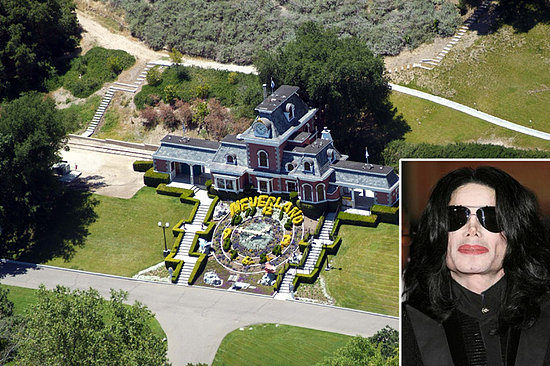
Jackson's mansion to turn into music school


King of pop Michael Jackson's house Neverland Ranch might turn into a music school for teenagers soon.
The mansion owners want to turn the building into a fame school for teenaged musicians, where children from all walks of life could learn to write and perform music, reports thesun.co.uk.

"It's an interesting idea and we'd be open to it," said a spokesman for Jackson's estate.

The mansion is owned by a private real estate firm Colony Capital that is looking into using Jackson's name to promote the venture.

However, Santa Barbara County officials are yet to sign the project.

Wednesday, December 8, 2010

MJ's glove sold for 330,000 dollars at auction

Michael Jackson's glove sold for 300,000 dollars at an auction.

Items from Jackson''s stage wardrobe were included in an auction of celebrity memorabilia in Beverly Hills, reports Fox News.


Julien''s Auctions said a lone glove worn by Jackson during the 'Bad' tour in the late 1980s sold for 330,000 dollars at the 'Icons and Idols' auction Saturday night.

A jacket signed by Jackson brought in 96,000 dollars and a fedora he wore on stage went for 72,000 dollars at the Julien''s Auctions event.

Other highlights from the auction were an x-ray of Albert Einstein''s brain, which brought 38,750 dollars, and a pair of Marilyn Monroe''s empty prescription bottles sold for 18,750 dollars.

A military-style jacket worn by John Lennon for a 1966 Life Magazine photo shoot sold for 240,000 dollars.

The two-day event brought in more than 3 million dollars.
Related Posts Plugin for WordPress, Blogger...